加入支持让我们有继续维护的动力!会员畅享查看所有预告
立即购买
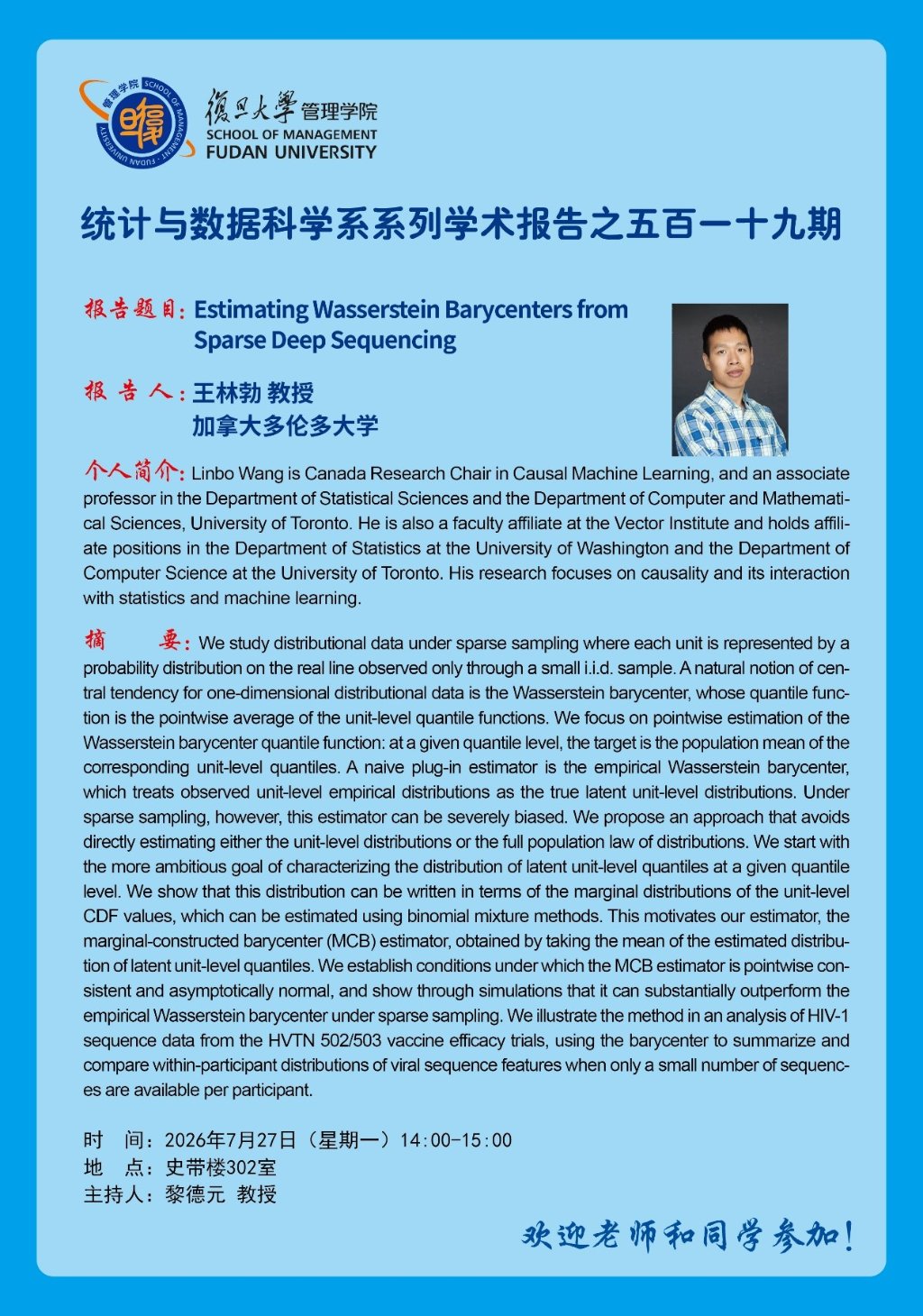
统计与数据科学系系列学术报告之五百一十九期
- 来源:
- 学校官网
- 收录时间:
- 2026-07-18 03:03:19
- 时间:
- 2026-07-27 14:00:00
- 地点:
- 史带楼302室
- 报告人:
- 王林勃 教授
- 学校:
- 复旦大学
- 关键词:
- Wasserstein Barycenter, Sparse Sampling, Distributional Data, Quantile Function, Causal Machine Learning, Statistical Sciences
- 简介:
- We study distributional data under sparse sampling where each unit is represented by a probability distribution on the real line observed only through a small i.i.d. sample. A natural notion of central tendency for one-dimensional distributional data is the Wasserstein barycenter, whose quantile function is the pointwise average of the unit-level quantile functions. We focus on pointwise estimation of the Wasserstein barycenter quantile function: at a given quantile level, the target is the population mean of the corresponding unit-level quantiles. A naive plug-in estimator is the empirical Wasserstein barycenter, which treats observed unit-level empirical distributions as the true latent unit-level distributions. Under sparse sampling, however, this estimator can be severely biased. We propose an approach that avoids directly estimating either the unit-level distributions or the full population law of distributions. We start with the more ambitious goal of characterizing the distribution of latent unit-level quantiles at a given quantile level. We show that this distribution can be written in terms of the marginal distributions of the unit-level CDF values, which can be estimated using binomial mixture methods. This motivates our estimator, the marginal-constructed barycenter (MCB) estimator, obtained by taking the mean of the estimated distribution of latent unit-level quantiles. We establish conditions under which the MCB estimator is pointwise consistent and asymptotically normal, and show through simulations that it can substantially outperform the empirical Wasserstein barycenter under sparse sampling. We illustrate the method in an analysis of HIV-1 sequence data from the HVTN 502/503 vaccine efficacy trials, using the barycenter to summarize and compare within-participant distributions of viral sequence features when only a small number of sequences are available per participant.
- -/- 5
报告介绍:
统计与数据科学系系列学术报告之五百一十九期
报告人介绍:
Linbo Wang is Canada Research Chair in Causal Machine Learning, and an associate professor in the Department of Statistical Sciences and the Department of Computer and Mathematical Sciences, University of Toronto. He is also a faculty affiliate at the Vector Institute and holds affiliate positions in the Department of Statistics at the University of Washington and the Department of Computer Science at the University of Toronto. His research focuses on causality and its interaction with statistics and machine learning.
报告图片: